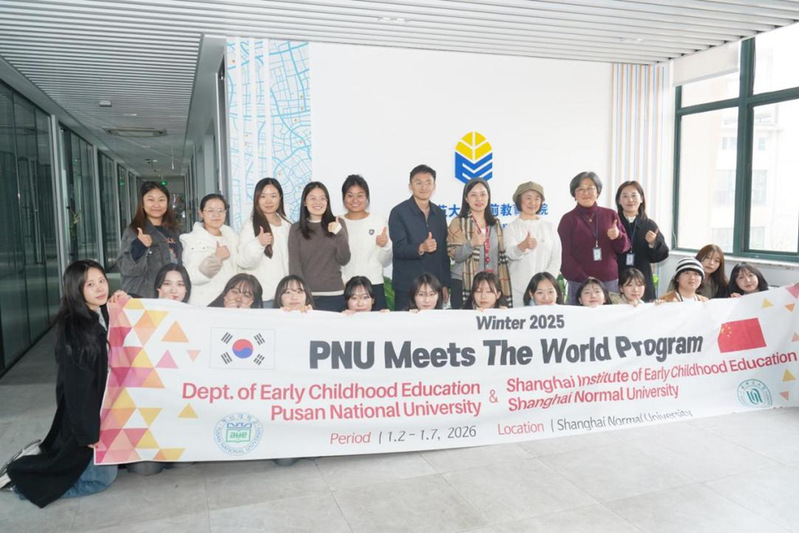
Recently, Jin-Young Chae, Vice Dean of the Faculty of Education at Pusan National University (PNU) in South Korea and a professor in the Department of Early Childhood Education with, led a delegation of faculty and students from the department to visit SHNU School of Early Childhood Education. The delegation conducted a two-day visit for inspection and in-depth professional exchanges.
During their visit, the faculty and student delegation from Pusan National University visited the Affiliated Kindergarten of SHNU and Ziwei Experimental Kindergarten. Through various activities such as on-site observations, classroom observations, and cultural inspections, they gained a comprehensive understanding of China's preschool education institutions and advanced practices in kindergarten culture development, the implementation of distinctive curricula, and the refined organization of children's daily life. The two parties engaged in lively discussions on hot topics such as optimizing kindergarten curriculum operation mechanisms, building support systems for teacher professional development, and innovating collaborative education pathways between universities and kindergartens, sharing valuable practical experiences and innovative approaches. They also conducted in-depth, comprehensive discussions and exchanges on key issues, including the current status and trends in preschool education development between China and South Korea, the construction of research-oriented teacher training systems, curriculum optimization and the establishment of practical platforms, innovations in research organization models, and the latest developments in international preschool education research.
The visit of the faculty and student delegation from Pusan National University of Korea has not only further deepened the mutual understanding and traditional friendship between the two universities in the field of preschool education but also led to multiple cooperation intentions in academic research, talent cultivation, faculty and student exchanges, and the joint establishment of practical platforms. This lays a solid foundation for future regular, multi-level, and wide-ranging practical cooperation between the two parties.